
Ghrita by Brve
Made the long way,
on purpose.
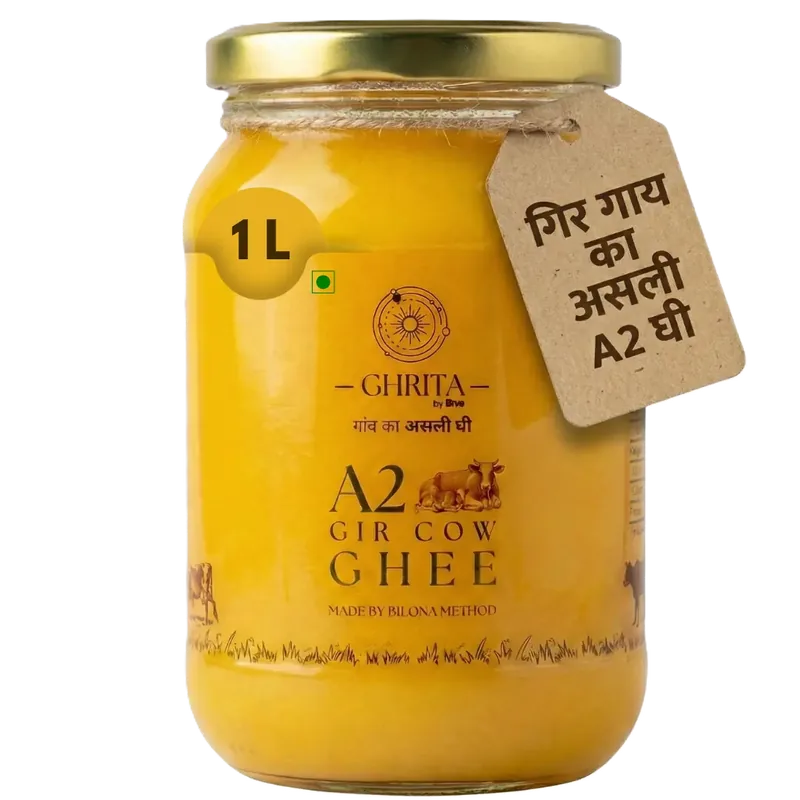
Most ghee sold as “desi” is boiled cream — faster, cheaper, and not bilona. Ours is set into curd first, hand-churned, then simmered over a wood fire for hours. It takes longer and costs more, and this page shows you exactly where that difference goes.
- 99.84%
- Pure milk fat
- 25–30 L
- Milk per litre of ghee
- 0
- Additives, ever
Filmed at our own farm
Churned from curd, not cream.
Most “desi ghee” is boiled cream — quicker, cheaper, and it is not bilona. Here is the longer way, in five steps, on video.
One litre of this takes 25–30 litres of A2 Gir cow milk. That milk alone costs us ₹1,200–1,500 — before the churning, the fuel, the jar or the lab test.
Gir cows, grazing free
Not a shed. Native Gir cattle, raised on open grass.
Curd, then churn
The whole milk is set into curd first. This is the step everyone else skips.
Makkhan lifted by hand
Butter separates and is lifted off. No cream separator anywhere.
Simmered on wood fire
Slow heat over hours. Rushing it is what makes ghee smell flat.
Poured golden and grainy
Grainy, golden, and bottled in small batches.
Tested, not claimed
Six in ten Indian households don't trust the ghee they buy. Here is ours, on paper.
Read the full lab report →Want to check it yourself? Put a spoonful in a steel pan. Real ghee melts almost instantly and smells nutty. If it takes its time or leaves a residue, it isn't ghee — whoever sold it to you.